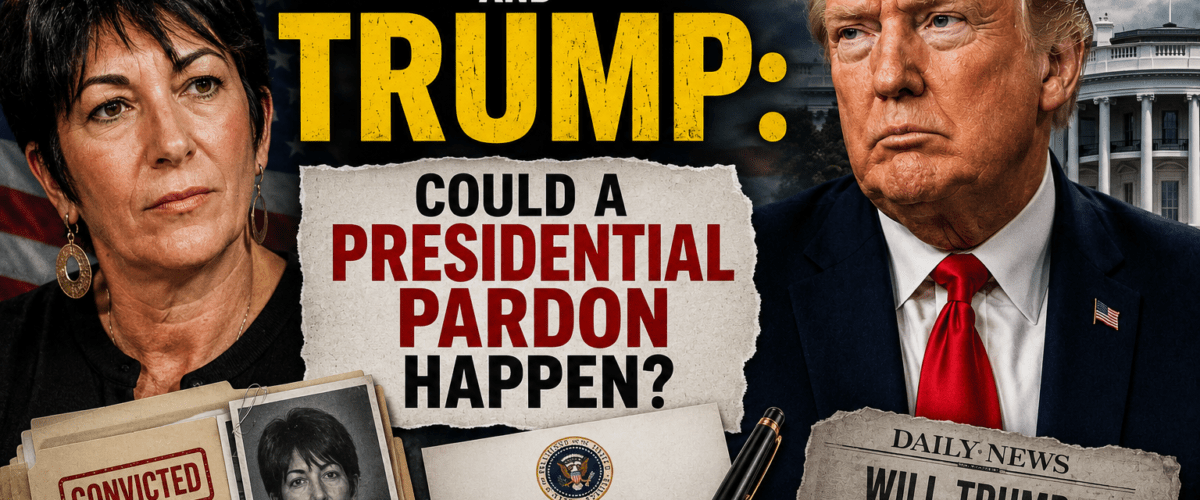
GHISLAINE MAXWELL AND THE TRUMP PARDON QUESTION: COULD IT REALLY HAPPEN?
Ghislaine Maxwell has few remaining legal options. With Trump having refused to completely rule out clemency, speculation about a pardon continues.
One name can instantly ignite America’s political conversation: Ghislaine Maxwell. Now the question is whether presidential clemency could ever become her last escape route.
Ghislaine Maxwell’s legal battle is approaching a critical stage.
Maxwell, Jeffrey Epstein’s longtime associate, is serving a 20-year federal sentence following her conviction for crimes connected to the sexual exploitation of minors.
As her legal avenues narrow, attention has returned to one politically explosive possibility:
Could President Donald Trump pardon her?
There is currently no announcement that Trump plans to pardon Maxwell.
That distinction is important.
But Trump has previously refused to completely rule out the possibility of clemency, and the issue has become a recurring source of political controversy. The U.S. Senate even unanimously passed a nonbinding resolution opposing a presidential pardon for Maxwell. (Reed Senate)
Why this is so explosive
The Epstein scandal has become one of the most politically sensitive stories in modern America.
It involves wealth.
Power.
Sexual abuse.
Celebrity connections.
And unanswered questions about who knew what and when.
Maxwell occupies a central place in that story because prosecutors established her role in facilitating Epstein’s abuse of girls.
That means any discussion of clemency immediately becomes politically charged.
Trump has not promised a pardon
This point needs to be emphasized.
There is a huge difference between:
“Trump is going to pardon Maxwell.”
and
“Trump has not ruled out clemency.”
The first is a factual claim requiring evidence.
The second is the actual political controversy.
Maxwell’s legal options may be narrowing, and reports have suggested that a presidential pardon could eventually become one of the few remaining avenues available to her. (The News International)
But speculation should not be presented as a decision.
Why Congress is watching
The Senate’s unanimous resolution opposing a pardon demonstrates just how politically radioactive the issue is.
The vote was nonbinding.
It does not legally prevent the president from exercising his pardon authority.
But politically, it sends a powerful message.
Even members of Trump’s own political coalition understand how explosive clemency for Maxwell would be.
What would happen if Trump actually pardoned her?
The political reaction would almost certainly be enormous.
Trump’s opponents would accuse him of abusing presidential power.
Some members of his own party could face pressure to distance themselves from the decision.
The Epstein story would return to the center of American political debate.
And every connection, allegation and unanswered question would be examined again.
Trump would likely argue that the president has constitutional authority to issue pardons.
That would be legally relevant.
But legal authority and political wisdom are not the same thing.
The broader question
The Maxwell controversy raises a fundamental question about presidential clemency.
Should presidents have almost unlimited discretion when deciding whom to pardon?
The Constitution gives presidents broad pardon powers for federal offenses.
That power exists for a reason.
But extraordinary power inevitably creates extraordinary controversy.
And when the person seeking clemency is connected to one of the most notorious criminal scandals in recent American history, the political consequences become almost impossible to avoid.
Public Verdict:
Don’t confuse speculation with news.
There is no confirmed Trump pardon of Maxwell.
But the possibility is politically significant because Trump has previously declined to rule out clemency and because Maxwell’s legal options are narrowing.
If such a pardon were ever granted, it could become one of the most controversial acts of Trump’s presidency.
What do you think?
Should a president have the power to pardon Ghislaine Maxwell—or should the seriousness of her crimes make presidential clemency politically unacceptable?